
SEO vs Google Ads, Which Is Better for a Small Business?
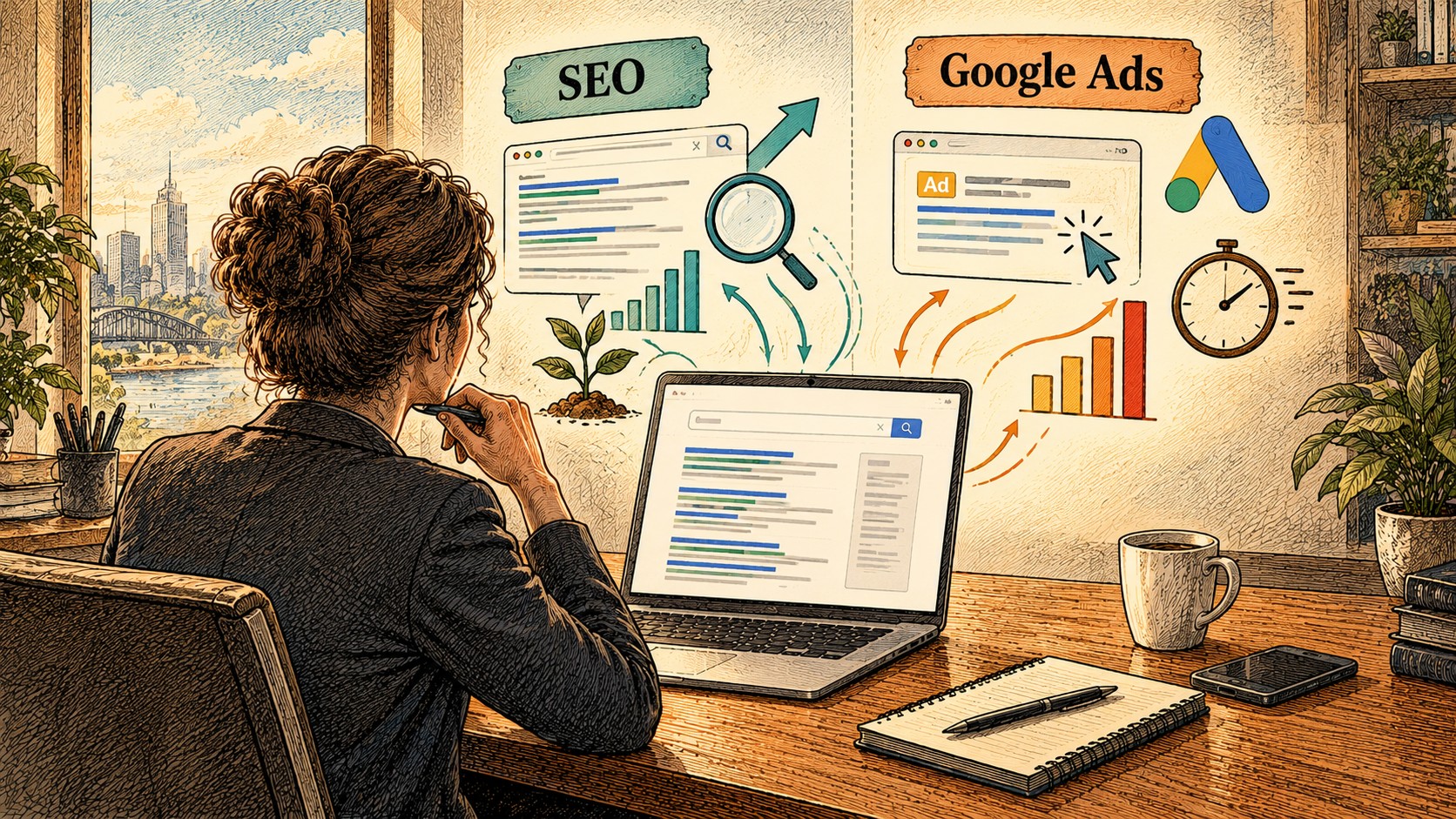
Every comparison of SEO vs Google Ads ends the same way, which is that you should do both. True, and unhelpful if you have fifteen hundred dollars a month and have to pick.
So this is a decision framework rather than a verdict. Below we cover what each channel actually does, the arithmetic on a small budget, how to sequence them, when each one is clearly wrong, and what to measure so the comparison stays honest.
What Each Channel Actually Does
Two of those rows are worth pinning down, because they are where comparisons usually overstate the case.
The first is the tap. Google confirms that pausing a campaign stops its ads from showing, and an exhausted daily budget has the same practical effect, so paid enquiries end the day the spend does. Organic traffic does not switch off that way, though it does not hold forever either. Rankings erode as competitors publish, pages age and search results change, so treat organic as an asset that needs maintenance rather than one that is finished.
The second is the timeline. Google's own guidance is less tidy than most comparisons suggest, noting that changes can take anywhere from several hours to several months to show up, and historically that meaningful benefits often take four months to a year. The three to six month figure practitioners quote is a working average for competitive commercial terms, not a rule.
The useful asymmetry survives both caveats. Paid search is a tap and organic search is an asset. One answers what you do this month, the other answers what you own in two years.
The Arithmetic on a Small Budget
This is where most comparisons go quiet, and it is the part that decides the answer.
What a modest paid budget buys
Divide your monthly budget by a realistic cost per click for your industry, then apply a conversion rate. The industry spread is wide. Benchmark data reported by Search Engine Land puts the all-industry average cost per click above five dollars with legal services close to double that, and those are United States figures, so use them as a shape rather than as your numbers. Our guide to cost per click in Australia gives local figures to work with.
Then the conversion step. Unbounce's analysis of landing page performance found a median conversion rate of a little over three percent, with wide variation by industry and page type. So at a few dollars a click, a thousand dollars a month might buy a few hundred clicks, and three percent of a few hundred clicks is a handful of enquiries. In expensive categories such as legal or trades in capital cities, the same budget buys materially fewer.
The learning period
New campaigns need data before they perform. Google says so directly, noting that a new or changed bid strategy goes through a learning period where performance fluctuates while the system gathers conversion data, and advises judging results only once enough conversions have accumulated. Practitioners put it more bluntly, which is that a very small budget can be consumed working out what converts before it produces a single lead. That is not a reason to avoid paid search. It is a reason not to split a tiny budget across two channels at once.
What a modest organic budget buys
At the same thousand dollars a month, you are buying hours rather than clicks, which might be one or two properly researched pages plus a few technical fixes. Nothing happens for weeks. Then, if the site foundations are sound, impressions start moving and enquiries follow.
A Decision Framework
Answer these in order and the choice usually resolves itself.
- Do you need enquiries within the next sixty days to keep the business healthy? If yes, paid search first. Organic cannot help you on that timeline.
- Does anyone search for what you sell? Check before you spend. Keyword Planner estimates monthly search volumes and forecasts clicks for the terms you care about. If volumes are negligible, neither channel is the answer and you need demand generation instead.
- Is your site technically sound and does it convert? If not, fix that before either channel, because both send traffic to the same pages.
- Can you commit for six months or more? Organic needs that. If your horizon is shorter, use paid.
- Are your margins high enough to absorb a cost per click in your category? If not, organic and local visibility matter more.
- Do you know which keywords convert? If not, a short paid test will tell you faster and cheaper than guessing in content.
The Sequence That Usually Works
For a small business with a constrained budget and a six to twelve month horizon, practitioners tend to land on the same order.
- Weeks one to four. Fix the foundations. Tracking, conversion paths, the technical basics, and your local listing if you serve an area.
- Months one to two. Run a tight paid campaign on your highest-intent terms. The goal is learning which words and offers produce enquiries, not scale. Exact and phrase match keywords, plus negatives, give you direct control over which searches trigger your ads, which is what makes the test readable.
- Months two to six. Shift weight toward organic, writing and optimising pages for the terms the paid data proved convert.
- Months six onward. Keep a small always-on paid presence for the terms you cannot yet win organically, and reinvest the difference as organic enquiries grow.
That order uses paid search as research rather than as a permanent cost, which is the most useful idea in this whole debate. Several practitioners say they wish they had done this earlier, not to scale ads but to learn what converted before committing to content.
How They Help Each Other
- Pages improved for organic search are better landing pages for ads. Google's Quality Score combines expected click-through rate, ad relevance and landing page experience, and while the score itself is a diagnostic rather than the auction input, higher ad quality is associated with better positions at lower cost
- Paid data shows which terms and offers convert, which makes organic content choices less speculative
- Appearing in both paid and organic results gives a brand more presence on the page for the same query
- Branded paid campaigns hold your own name prominently while organic authority builds. They do not stop rivals bidding on it, since Google's policy generally permits trademarked terms as keywords, but they do keep you above the competitor who is trying
- A single measurement setup serves both, so attribution gets better for everything
Measurement is the part that makes the comparison real. Without conversion tracking tying clicks to enquiries and sales, you are comparing anecdotes, and automated bidding has nothing reliable to optimise toward. Our data analytics work exists largely so these decisions rest on numbers.
When Each One Is Clearly Wrong
Do not start with paid search if
- Your margins cannot absorb the cost per click in your category
- Your website does not convert, since you will pay for traffic that bounces
- You cannot fund it continuously, because enquiries stop the day the budget does
- Nobody can manage or review it, as unattended campaigns waste money quickly
Do not start with organic if
- You need enquiries this month
- You cannot commit beyond a quarter
- Your site cannot be changed for platform or approval reasons
- Your category has almost no search volume
What To Measure
Compare the two channels on the same terms or the comparison is meaningless.
- Enquiries, not traffic. Form submissions, calls, bookings
- Cost per enquiry for paid, and cost per enquiry including retainer for organic
- Enquiry quality, since cheap leads that never buy are not cheap
- Revenue per channel where you can attribute it
- Trend over time, because paid is flat while organic should climb
You can see both patterns in our work. The paid search results for Practical Outcomes show what a well-run campaign does, and the Tynte Flowers local SEO work shows the organic side.
What To Do Next
Write down three numbers. Your monthly budget, how soon you need enquiries, and your average sale value. Those three answers decide this more reliably than any comparison piece, including this one.
How Bobo Digital can help
We run both channels in Adelaide, so we have no reason to push one. Our SEO services suit businesses building a compounding position, our Google Ads management suits those needing enquiries sooner, and our marketing strategy work is for deciding the mix before spending on either. Get in touch and we will tell you which one your situation actually calls for.
Key Takeaways
Paid search is a tap and organic search is an asset, so the question is really about your timeline and your margins. Need enquiries within two months, use paid. Can commit for six months or more, build organic. On a small budget, do not split the money evenly. Use a short paid test to learn which terms convert, then move weight into organic content for those terms, keeping a small paid presence where you cannot yet win. Fix tracking and conversion first, because both channels send traffic to the same pages, and compare the two on cost per enquiry rather than on traffic.
What Each Channel Actually Does
GET IN TOUCH
Got a project in mind? Want to chat about the latest in data-driven marketing? Or simply have a few questions? We're all ears. Drop us a line, shoot us an email, or swing by for a good old-fashioned chat over coffee. Our door is always open (well, within business hours) to talk shop or just to say hi. Let's connect and see where we can take your business with the right strategy.